
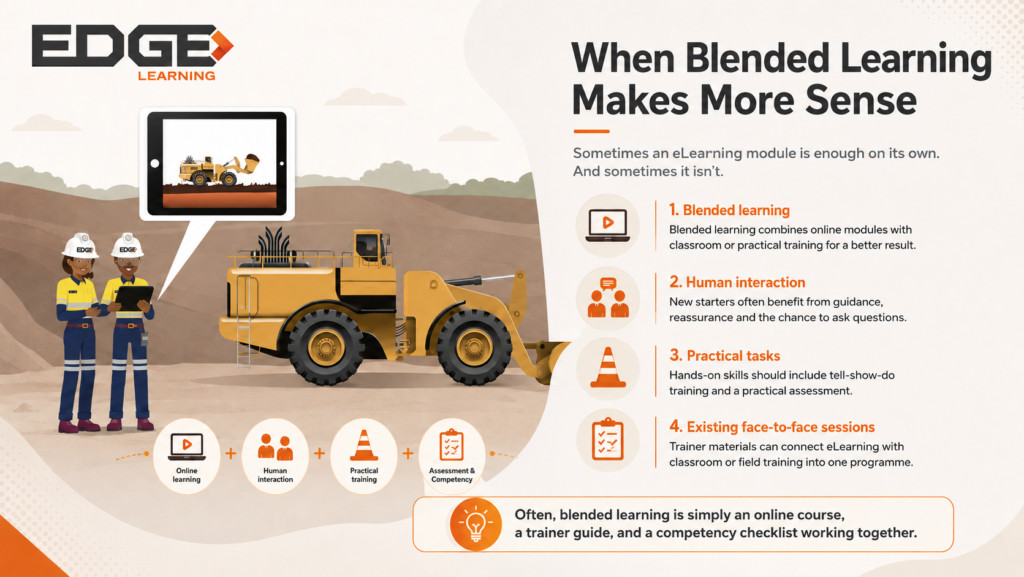
Sometimes an eLearning module is enough on its own. And sometimes it isn’t.
If the skill involves real equipment, on-the-job judgement, or working alongside a supervisor, blended learning may be a better option. Blended learning combines the convenience of online modules with classroom or practical training for a better result.
A few situations where a blended approach makes more sense include:
1. Where the value includes human interaction.
Sometimes, training is more than just a transfer of knowledge. For example, when new starters turn up on a site for the first time, an experienced training can make them feel welcome and reassure them as well as giving them information. They need to feel comfortable asking questions so they can be ready for work and confident in their surroundings.
2. Practical tasks.
eLearning can cover the theory well. But learning a practical task should always involve some variation of the tell-show-do method of training. And it should always require a practical assessment, whether it is simulated or real.
3. Trainers are already delivering face-to-face or field sessions.
If your team is running classroom or on-site training anyway, purpose-built trainer materials can tie the eLearning to those sessions and make both more effective. Rather than two separate things, they become one coherent programme.
Blended doesn’t have to mean complicated. Often it’s an online course, a trainer guide, and a competency checklist working together.
What’s been the prompt for you to look at blended learning rather than eLearning on its own?
Related: our mining training packages combine animated eLearning with workbooks, practical assessments and trainer guides, and the Hancock Iron Ore case study shows a blended package in use.