
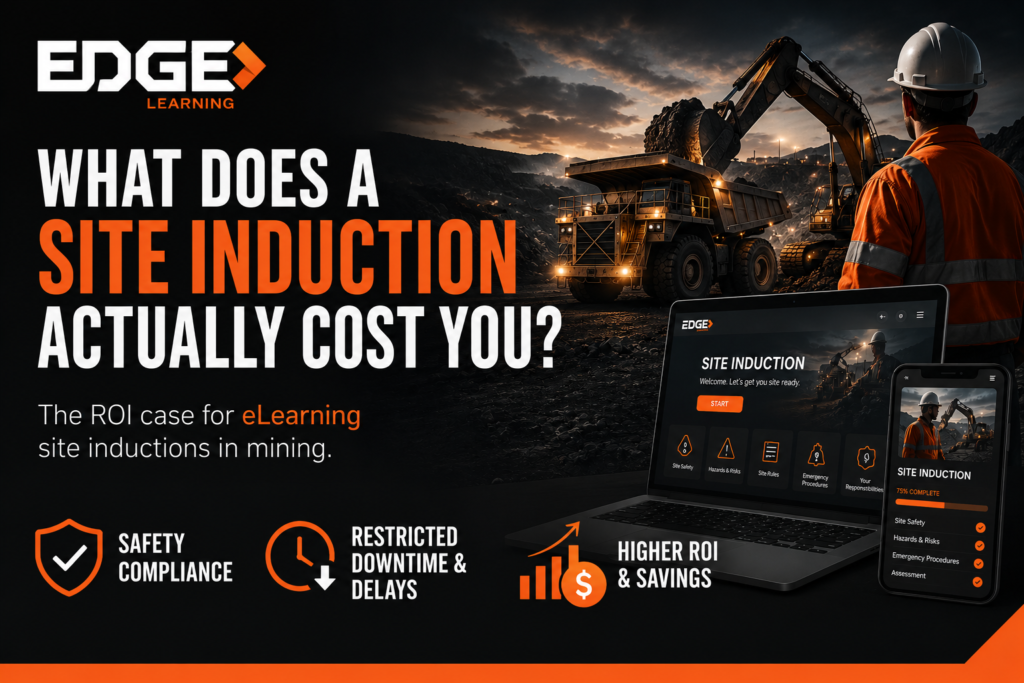
The ROI case for eLearning site inductions in mining
Every time a new employee or contractor sets foot on a mining site, they need to be inducted. That is not negotiable. What is negotiable is how the induction gets delivered, how long it takes, and what it costs when you add everything up. Not every course is best delivered through elearning. But there are some that are worth considering and site inductions may be one of them.
Face-to-face inductions are the default. They work, but they carry costs that rarely make it onto a line item: a trainer pulled from their other duties, a room occupied for an hour or more, workers sitting through content they already know, and a process that cannot begin until the person is physically on site. When you run high volumes of new employees and contractors through a site, those costs add up fast.
Where the ROI of an elearning induction comes from?
Workers complete the induction before they arrive on site. That turns day one from an administrative half-day, at a minimum, into productive time. For a site bringing on 50 contractors a month, getting even two hours back per person adds up to over 1,200 hours of recovered productivity across a year.
Instructor time is redirected. A trainer running a 4 hour face-to-face induction twice a week is spending over 400 hours a year on content delivery. And that doesn’t include time spent printing, scanning and filing that goes along with face to face courses.
Every worker gets the same induction. Consistency matters for compliance. When the content is delivered face-to-face, what gets covered varies by who is presenting, what questions come up, and how much time is available. An eLearning induction is the same every time, which means your audit trail reflects what was actually delivered, not what you hope was covered.
Records are automatic. Completion data, quiz scores, and timestamps are captured without anyone needing to file a sign-in sheet. When an auditor or insurer asks who completed what and when, the answer is in the system.
The content can be updated without reprinting anything. Procedures change. Emergency contacts change. When the induction is eLearning, you update it once and every future completion reflects the current version. With a printed workbook or a presenter using slide notes from 18 months ago, that is not guaranteed.
What to expect on the cost side?
A well-built eLearning site induction for a mining environment typically runs between $10,000 and $30,000 depending on scope, complexity, and whether custom animation is involved. That sounds like a significant spend until you model it against the cost of running the same induction face-to-face over 12 months. For sites doing more than 10 inductions a month, the break-even point sits well inside the first year.
The second and third years cost almost nothing. Updates are minor. Hosting is minimal. The content keeps working without anyone running it.
A note on context
eLearning inductions work best when the content is designed for the environment. Mining sites have specific hazards, specific emergency procedures, and often specific regulatory requirements that generic eLearning templates do not account for. An induction built from a standard off-the-shelf template may satisfy a checkbox. One built around your actual site conditions and workforce is more likely to land.
If you are running high volumes of contractors through a site and you are still relying on face-to-face delivery, it is worth doing the numbers. The ROI case for eLearning site inductions in mining is not complicated. The main question is usually not whether it makes sense, but what it should cover and who should build it.
Edge Learning builds eLearning site inductions for mining and resources companies. If you would like to talk through what a site induction for your workforce might look like, get in touch at [email protected]
Related: see our professional eLearning for site inductions, the Genesis Minerals online induction case study, and the eLearning price guide.