
AI has changed how quickly training content can be drafted. What used to take days of writing can now be produced in an afternoon, and plenty of organisations are experimenting with it for their own training.
Used well, it is a real asset. But there is a growing assumption that AI can now do the whole job, and that is where organisations tend to get into trouble. It helps to be clear about what AI is good at, and what still needs a professional eLearning developer.
Where AI helps
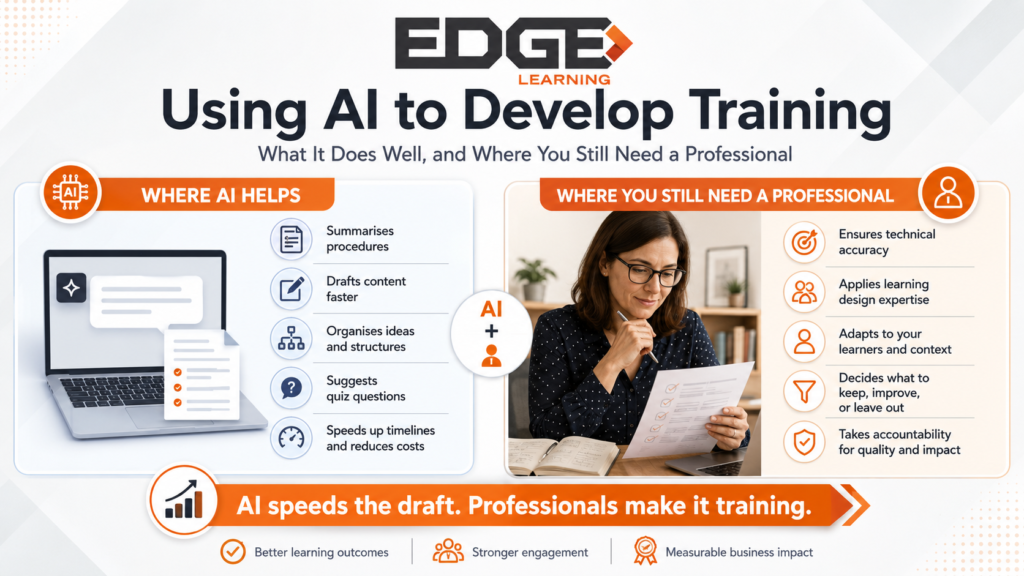
AI is useful for the heavy lifting around content. It can summarise long procedures, tidy up rough subject-matter-expert notes, draft first-pass text, suggest quiz questions and help structure ideas. For a developer, that speeds up the early stages of a project considerably, and those savings can flow through to timelines and budgets.
If you are building training in-house, AI can help you get a rough draft on the page much faster than starting from a blank screen.
Where it falls short
The problems start when AI output goes straight into a course. A few things to watch for:
Technical accuracy. AI does not know your site, your equipment or your procedures. It will write confidently about things it has never seen, and in safety-critical environments a plausible-sounding error is worse than a blank space. Everything needs checking against how the work is actually done.
Knowing what to leave out. AI is good at generating content and poor at cutting it. Effective training is usually defined by what is removed. Deciding what a learner must know, rather than everything they could know, is a design decision, not a writing task.
Learning design. A wall of well-written text is not a course. Sequencing content, choosing the right interactions, building realistic scenarios and writing assessments that measure real performance is instructional design work, and AI does not do it for you.
Your learners. AI defaults to generic, office-flavoured language. It does not know the literacy levels, cultures and experience of your workforce, and content that talks down to experienced frontline workers loses them quickly.
Accountability. When training is challenged after an incident, “the AI wrote it” is not a defence. Someone qualified needs to stand behind the content.
The combination that works
None of this is an argument against AI. A good eLearning developer is likely using it already, to work faster on the parts it is suited to, while applying professional judgement to accuracy, design and the learner experience. That combination tends to produce better training, sooner, than either one alone.
The question worth asking a provider is not whether they use AI, but how. A good developer will be happy to explain where it fits in their process and where a human makes the decisions.
Where to from here
If you are weighing up how AI fits into your training development, or you have AI-drafted content and are not sure it is ready for your workforce, we are always happy to have a conversation. Get in touch and we can talk it through.
Related: see how we build custom eLearning and our animated eLearning for mining safety.