
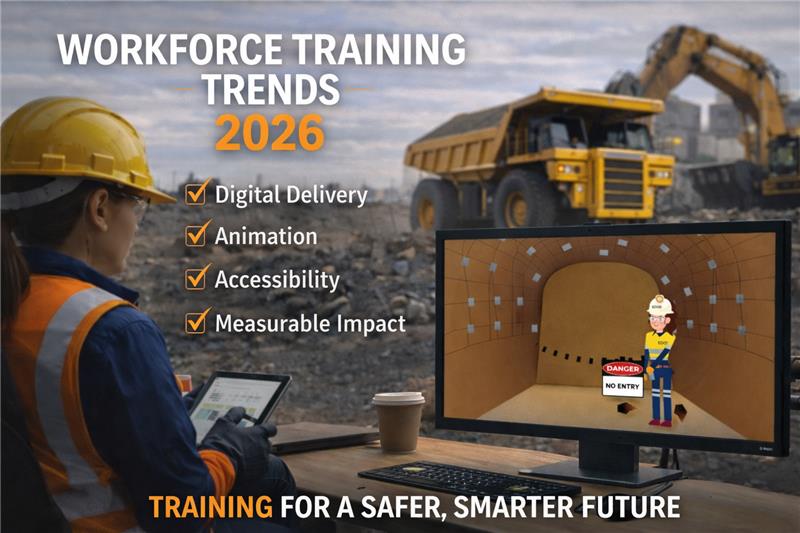
Digital delivery. Animation. Accessibility. Measurable impact.
Workforce training in the resource industry is changing — and it needs to.
The old model of long PowerPoint inductions, overloaded compliance slides, and “tick-the-box” completion certificates simply isn’t enough anymore. Not when safety standards are rising. Not when workforce mobility is increasing. And not when leadership teams are demanding measurable outcomes.
As we move through 2026, we are seeing four clear shifts shaping the future of induction and workforce training.
1. Digital Delivery Is Now the Standard — Not the Upgrade
Digital inductions are no longer considered innovative. They’re expected.
Remote sites, contractor mobility, and scalable workforce onboarding demand training that can be delivered consistently, tracked properly, and updated efficiently.
Paper-based systems and static slide decks create friction:
- Manual tracking
- Version control issues
- Inconsistent messaging
- Audit vulnerabilities
Digital delivery solves those problems — but only when it’s professionally designed.
Simply uploading a slide deck to an LMS doesn’t modernise your training. Structure, clarity, and engagement still matter.
2. Animation Is Replacing Static Content
In high-risk industries, clarity isn’t optional.
Animation allows us to:
- Visually demonstrate hazards
- Show cause and consequence
- Reinforce correct behaviours
- Simplify complex procedures
When workers can see a scenario unfold, retention improves. Engagement improves. And more importantly, understanding improves.
This isn’t about making training “entertaining.”
It’s about making it effective.
The resource industry is recognising that well-designed animated inductions are more aligned with how adults actually learn.
3. Accessibility Is Becoming Non-Negotiable
Workforces are more diverse than ever.
We’re designing for:
- Multilingual teams
- Varying literacy levels
- Remote accessibility
- Mobile device compatibility
Clear language. Strong visuals. Structured pacing. Captioning. Logical flow.
Accessibility isn’t just about inclusion — it’s about risk reduction. If someone doesn’t fully understand site expectations, the consequences can be serious.
Training must be designed so everyone can engage with it confidently.
4. Measurable Impact Matters More Than Completion Rates
Completion certificates don’t prove competence.
In 2026, organisations are asking better questions:
- Did behaviour change?
- Did incidents reduce?
- Did onboarding time improve?
- Is training defensible during audit?
Training is no longer viewed purely as compliance. It’s being recognised as risk mitigation and operational strategy.
This shift is important.
When induction is treated as a strategic asset — not an administrative task — standards rise across the organisation.
What This Means for the Resource Industry
The common thread across all these trends is simple:
Training must be intentional.
Digital delivery alone isn’t enough.
Animation alone isn’t enough.
Compliance alone isn’t enough.
Workforce training in 2026 needs to be:
- Professionally structured
- Visually clear
- Accessible to diverse teams
- Measurable in its impact
Inductions are often the first experience someone has with your site. They set expectations. They influence behaviour. They signal standards.
If we want stronger safety cultures and more operational consistency, it starts there.
And it starts with designing training properly.
If you’re reviewing your inductions this year, now is the time to ask:
Are they just compliant — or are they effective?